
devos from the hill


Leave a comment

Two Trees – Two Ways

Two approaches to God – works and grace
Lesson 11 from The HOPE Study Guide

Introduction

And out of the ground the Lord God caused to grow every tree that is pleasing to the sight and good for food; the tree of life also in the midst of the garden, and the tree of the knowledge of good and evil… And the Lord God commanded the man saying, “From any tree of the garden you may eat freely; but from the tree of the knowledge of good and evil you shall not eat, for in the day that you eat from it you shall surely die.

– Genesis 2: 9, 16-17

In the middle of the garden, there were two trees. One was the tree of life, the other, the tree of the knowledge of good and evil. God told Adam he could eat from any tree in the garden, but from the tree of the knowledge of good and evil he must not eat, for when he does he will surely die.

– The HOPE, Chapter 2

Observe & Consider

Thus far in God’s story, we’ve witnessed much drama, but no conflict. God created Adam and Eve and placed them in a beautiful garden where they had all they needed. But two trees stood in the midst of the garden. One tree yielded life, the other death; first a spiritual death, and ultimately a physical death.

Bible scholars throughout history have considered the meaning of these two trees. Most agree that the trees represent two entirely different ways of relating to God and life.The tree of the knowledge of good and evil is thought to represent man’s attempt to be fulfilled, and rightly related to God, through his own effort – often by acquiring knowledge and trying to do what is right in His own eyes. The Bible says the end of this approach is death.2

However, the tree of life is, according to theologian John Calvin, a reminder to man that “he lives not by his own power, but by the kindness of God; and that life is not an intrinsic good, but proceeds from God.” 3 The tree of life represents the life–giving favor which flows from God – favor we do not merit and cannot earn, but can only receive in humility and thanksgiving. Continue reading

2 Comments

Creation of Adam & Eve – Part 2

Our purpose – to glorify God by enjoying Him forever.
Lesson 10 from The HOPE Study Guide

INTRODUCTION

He did not create them to be gods. But as the moon reflects the light of the sun, so Adam and Eve were created to reflect the light of God.

– The HOPE, Chapter 1

The chief end of man is to glorify God and enjoy Him forever.

– Westminster Catechism, Shorter Version, Written in the 1640’s

OBSERVE & CONSIDER

In the previous lesson we considered the truth that man was created in the image of God. In this lesson we will consider God’s purpose for creating man. There are many verses in the Bible that, if studied in total, would help us understand God’s purpose for creating man. However, there is not just a verse that singularly sums up this subject, at least not in a manner that would satisfy most Bible scholars.

There is, however, a document containing a statement that attempts to sum up what the Bible says about God’s purpose for creating man. This document is known as the Westminster Catechism, and the statement to which we are referring appears above. This statement is widely accepted among Bible scholars as accurate, and it provides a point of reference as we consider what The HOPE says about God’s purpose for creating man.

Without a doubt, the brightest visible object in our world is the sun. It is so bright that gazing directly at it can cause irreparable damage to our eyes. Yet God’s brilliance is immeasurably greater than even that of the sun. In 1 John 1:5 we learn that God is pure, undiluted light. And in Exodus 33:20 we are told that His glory is so great no man can look directly at God and live! So how can people behold the glory of God if He is so intensely brilliant that no man can look directly at Him and live? Continue reading


1 Comment

Creation of Adam & Eve – Part 1

What makes a human different from all of creation?
Lesson 9 from The HOPE Study Guide

INTRODUCTION

Then God said, “Let Us make man in Our image, according to Our likeness; and let them rule over the fish of the sea and over the birds of the sky and over the cattle and over all the earth, and over every creeping thing that creeps on the earth.” And God created man in His own image, in the image of God He created him; male and female He created them.

– Genesis 1: 26-27

And on the sixth day, after God had created everything else, He formed the first man out of the dust of the earth. Then He breathed life into the man and the man became a living being. God called him Adam. And from the very flesh of the man, God created the first woman. Adam called her Eve. And Adam and Eve were different from all of creation, for God created them in His own image.

– The HOPE, Chapter 1

OBSERVE & CONSIDER

Notice from The HOPE excerpt and the Bible verse above that man was created “in the image of God.” What does it mean to be made in God’s image? To answer this question people often cite characteristics in humans that are similar to the characteristics they attribute to God. These might include the capacity to be creative, to reason, to make choices, communicate, and experience complex emotions.

Some would argue that certain animals display (to some extent or another) many of these same “God–like” characteristics. They would say (rightly or wrongly) that the primary distinction between humans and animals is not one of essence or nature, but rather one of degree, and that humans are only more highly developed (or evolved) animals. Yet the Bible says that “God created man in His own image,” a distinction not given to any other creature.

Genesis 2:7 offers some important insight in this issue:

“Then the Lord God formed man of dust from the ground, and breathed into his nostrils the breath of life; and man became a living being.”

Notice from this verse that after forming man’s physical being from the dust of the ground, God “breathed into his nostrils the breath of life; and man became a living being.” The Hebrew word (nephesh) translated here as “being” may also be translated as “soul.” Soul refers to the nonphysical or nonmaterial part of a person. Some people believe that animals, too, have “souls.” Whether that is the case is not the point here. What’s significant is that – according to the Bible – the way in which man received a soul is entirely unique to man. He received it directly from God Himself! Continue reading


1 Comment

Working Out Your Salvation – Your Role and God’s Role

Mars Hill Staff Devotional
from Fred Carpenter

“. . . work out your salvation with fear and trembling; for it is God who is at work in you, both to will and to work for His good pleasure.” – Philippians 2:12b-13

Most religions of the world teach that by following their tenants you will over time be changed into a different, better person. The Bible, on the other hand, teaches that the moment you are born again (Eph. 2:4-7, John 3:1-6, Tit. 3:5), God changes you into a new creature (2 Cor. 5:17). He plants a new nature in you (makes you a partaker of His divine nature 2 Peter 1:4), and the rest of your life on earth becomes a process of cooperating with Him to grow and mature that new nature as an expression of His life in and through you. This process is what the Bible calls sanctification.

Perhaps nowhere else in the Bible is this truth so powerfully and succinctly stated than in Philippians 2:12-13. Here we apprehend a truth that may require a lifetime or more to comprehend. Jonathan Edwards expressed the importance of understanding this verse, writing that, “from St. Paul a sentence hit me when I was about twenty-two that has shaped my theology ever since, ‘Work out your salvation with fear and trembling for it is God who works in you to will and to do His good pleasure.’”

In two sentences, this passage sums up the responsibility of man and the sovereignty of God. Here, we have come upon a new math. The natural mind can calculate x%(God’s role) + x%(man’s role)=100%. But the equation in this verse is only completed with 100% God and 100% man. In the realm of theology, “quietists” stress God’s role in sanctification, to the virtual exclusion of any human effort. “Pietists”, on the other hand, emphasize self-effort at the expense of reliance on God’s power. Here, Paul makes no attempt to reconcile divine sovereignty and human responsibility, but boldly proclaims both. Continue reading


3 Comments

He Is Our Peace

Mars Hill Staff Devotional
from Fred Carpenter

The scene was Israel about 1160 years before Christ. The Midianites were causing great suffering among the Israelites. Gideon was threshing wheat when God called Gideon and told him that he would deliver his people. Like so many others called by God to accomplish a God sized mission, Gideon was feeling uneasy about the task before him. The Lord said to him, (Judges 6:23) “Peace to you, do not fear; you shall not die.” 24 Then Gideon built an altar there to the Lord and named it The Lord is Peace. To this day it is still in Ophrah of the Abiezrite.

The phrase “The Lord is Peace” is the focus of today’s devotional. To understand it, we must go back to the time when (in Exodus 3) God told Moses to return to Egypt to deliver his people. Moses responded “Indeed, when I come to the children of Israel and say to them, ‘The God of your fathers has sent me to you,’ and they say to me, ‘What is His name?’ what shall I say to them?” And God said to Moses, “I Am Who I Am.” And He said, “Thus you shall say to the children of Israel, “I Am has sent me to you.” Exodus 3:13,14.

“I Am Who I Am” is the closest translation (or more exactly, transliteration) of a Hebrew word that cannot actually be pronounced. The closest Latin transliteration is actually YHWH. Notice, there are no vowels, only consonants. This name of God cannot be pronounced. Still in order to make this word accessible, scholars eventually added vowels and this word became Yahweh, or for some, Jehovah. Continue reading


1 Comment

Our Blessed Hope

Mars Hill Staff Devotional
(Part 3 of 3-part series)
from Fred Carpenter

“. . . looking for the blessed hope and the appearing of the glory of our great God and Savior, Christ Jesus,” – Titus 2:13

I’ve witnessed this scene several times in my life. I’m in a room of people. It could be a classroom, a dining room or a conference room. An important person enters the room. The mood in the room immediately changes and the people begin to act different than only a moment before.

What if you knew that Jesus was going to walk into your world right now? That before you finish whatever you’re doing, whatever activity you’re engaged in, you would see Him face to face? Would it make a difference?

The apostle John was dealing with a similar thought when he wrote, “Now, little children, abide in Him, so that when He appears, we may have confidence and not shrink away from Him in shame at His coming.” – 1 John 2:28. What a terrible thought, to shrink away from Him in shame!

For those who love Him, His return should be something entirely different than what John is describing. In fact, in Titus 2:3, Paul calls it our “blessed hope.” And why does he use this descriptive?

It is blessed because of all that the Savior’s return will mean to us as believers in Christ. Hampton Keathley reminds us that His coming for us means . . .

  • transformation or glorification (glorified resurrection bodies),
  • reunion (meeting loved one and friends who have died in the Lord),
  • remuneration (evaluation for and the giving of rewards for faithful service), and
  • reigning with Christ in the glorious future that follows

According to Ray Stedman, “One of the great reasons the church is so confused in this day, one of the reasons the church says so little of true significance to the world, is that it has neglected and abandoned, by and large, the hope of the coming of the Lord. There are very few sermons preached on it. There is very little said about it. There is no time given to a consideration of what this hope means and why it is set forth so frequently and so clearly in the Scriptures. Great sections of the Scriptures that deal with the hope of our Lord’s return are simply ignored by Christians.”

The Bible teaches us that the return of Christ is imminent (James 5:8). If we really believe that, it will change the way we live. The great preacher F. B. Meyer once asked D. L. Moody, “What is the secret of your success?” Moody replied, “For many years I have never given an address without the consciousness that the Lord may come before I have finished.”

Speaking of our blessed hope, Spiros Zodhiates said, “Our hearts will be propped up if we live in the constant expectation of His coming.” Did you know that 1 in every 20 NT passages refers to the Second Coming either directly or indirectly! God intends that our blessed hope, the promise of His return would motivate us to Godly living, encourage us to persevere and reorient our priorities.

“You too be patient; strengthen your hearts, for the coming of the Lord is near.” – James 5:8 NASB

Additional Reading Continue reading


2 Comments

Are You Ready for Another Day of Labor?

Mars Hill Staff Devotional
from Fred Carpenter

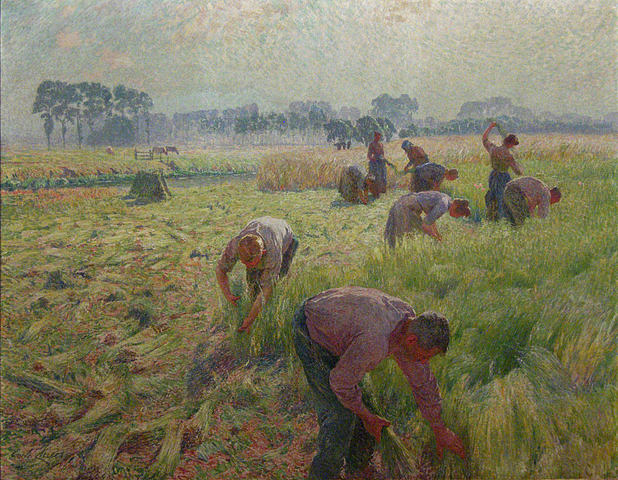
Emile_Claus-the_Harvest

Does the title to this devotional cause a happy feeling to rise up within you? Probably not. Many of our feelings about work are no doubt shaped by the curse that came after the fall (Gen.2:17-19.) But God, who redeems fallen things, is able to change our perspective on work.

On June 24, 1894 Congress passed a law making the first Monday in September a legal holiday, Labor Day. Yesterday was that day. How did it work out for you? On the morning after, were you ready for another day of labor, or would you rather have another day off?

Paul closes the 15th chapter of 1 Corinthians with a strong statement that speaks directly to our attitude about labor. “Therefore, my beloved brothers, be steadfast, immovable, always abounding in the work of the Lord, knowing that in the Lord your labor is not in vain.” (v.58). Reading this verse, two questions jump out, “What is the work of the Lord?”, and “Why should we have this attitude about it?” Continue reading


3 Comments

Free from the Fog of Fear

Mars Hill Staff Devotional
from Fred Carpenter

“There is no fear in love; but perfect love casts out fear, because fear involves punishment, and the one who fears is not perfected in love.” 1 John 4:18 NASB

Today we are talking about fear. Not the kind of fear that suddenly grips you with terror, but the kind that lurks below the surface of your conscious mind. The fear we equate with terror comes on us in an instant, like a life-threatening wound from a gunshot. The kind of fear we are talking about today is more like a slow moving disease. It’s the kind of fear you may not even be aware of, or have forgotten was there, until you’re faced with a challenge (or an opportunity) that reminds you of its power.

This is the kind of fear every one of us inherited as a son of Adam. This kind of fear can rob you of peace and joy, and keep you from running unencumbered toward your destiny. This kind of fear can bring the flow of your life to a standstill, just as a dense fog can bring the vibrant flow of traffic in a busy city to a dead halt.

But consider this, according to the Bureau of Standards in Washington, a dense fog, covering seven city blocks to a depth of 100 feet is composed of less than one glass of water. That amount of water is divided into about 60 billion tiny droplets. Yet when those minute particles settle over a city or the countryside, they can almost blot out everything from sight. Continue reading


Leave a comment

Beware of the Need to Know

Mars Hill Staff Devotional
from Fred Carpenter

“The secret things belong to the LORD our God, but the things revealed belong to us and to our sons forever, that we may observe all the words of this law.” – Deuteronomy 29:29 NASB

Are you an information junkie? Where does checking the news (financial, sports, political, etc.) fit into your daily routine? Do you have a need to know things you don’t really need to know? Do you have a need to know why God has brought (or allowed) something into your life before you can embrace it? Do have a need to know why before you follow the instructions of someone in authority over you, be it God or man? Do you tend to over plan and over prepare before moving forward?

The Bible has a great deal of positive things to say about being sober minded, diligent and wise as we walk in this world. But there is a difference between counting the cost (which is encouraged in the Bible – Luke 14:28) and trusting in what we can count rather than trusting in God.

In 1 Chron. 21:1, we read that “Satan stood up against Israel, and moved David to number Israel.” Satan exploited David’s “need to know”. But “God was displeased with this thing, so He struck Israel.” – 1Chron. 21:7. A census is not evil in and of itself, but in this situation, it was the how and why of the census that resulted in God’s anger toward David.

First, the instructions for numbering the people were given in Exodus 30:12. David did not follow those instructions. Second, David’s census was a violation of ownership. A person only has the right to inventory what he owns. You can’t go into your neighbor’s house and count his possessions without his permission. By taking this census, David was saying, these are my people. He is not acknowledging God’s ownership of the people. He counted them as if they were his. And finally, David’s census reveals that he was not trusting in God. Counting men was a king’s way to determine the size of his army. But it revealed that David was depending on human strength rather than on God. David’s census was rooted in unbelief, and the consequences were disastrous. God sent a plague which killed 70,000 men.

Satan also spoke to Eve’s “need to know”. In Genesis 3:2-5 we read that “The woman said to the serpent, ‘From the fruit of the trees of the garden we may eat; but from the fruit of the tree which is in the middle of the garden (the tree of the knowledge), God has said, ‘You shall not eat from it or touch it, or you will die.’ The serpent said to the woman, ‘You surely will not die! ’For God knows that in the day you eat from it your eyes will be opened, and you will be like God, knowing good and evil.’”

Of course, we are all personally familiar with the result of that event. Eve acted on her innate “need to know” and sin entered the world, infecting mankind and bringing death to this very day.

Do you have a need to know things that you really don’t need to know . . . things that really belong to God? Spare yourself (and others) the grief. “You keep him in perfect peace whose mind is stayed on you, because he trusts in you.” – Isaiah 26:3

Some Key Take-aways by the staff:
1. It is one thing (& perfectly ok) to ask God, “why?” It is another thing to have to know before you can trust Him!
2. Parents can play a key role in how easy or difficult it is to superintend our need to know. As we are lead through early life by our parents, having to trust them without all the knowledge that they have, as they guide us, it builds our character for trusting and following God the Father.
3. Perhaps the ultimate purpose of knowledge is to bring us to the end of ourselves so that we can rely solely on God.


Leave a comment

The Deadly Folly of Doing God’s Work Man’s Way

Mars Hill Staff Devotional
from Fred Carpenter

The ark of the covenant; a chest of acacia wood, 45 inches long, 27 inches wide, and 27 inches deep. It contained the tables of the law, the pot of manna, and Aaron’s rod (Heb. 9:4). The lid of the ark was the place where God’s presence was manifested. During the days of Samuel, the Israelites took the ark from Shiloh into battle and lost it to the Philistines (1 Sam. 4:3-4; 10-11). In 1 Chronicles 13 and 2 Samuel 6 we read of David’s attempt to bring the ark from the land of the Philistines to Jerusalem.

What begins with seemingly good intentions ends with disaster. One of David’s men is struck dead by God when he tries to keep the ark from falling off a cart, and David becomes so angry about the matter that he just leaves the ark with a nearby family and returns to Jerusalem without it. What went wrong?

Counsel without Wisdom – David’s first step was to consult every leader in Israel regarding the matter. “Then David consulted with the captains of the thousands and the hundreds, even with every leader” (1Ch 13:1). But David did not seek God, or search the scriptures concerning the thing he was about to do. Apart from God there is no wisdom, even in a “multitude of counselors” (Proverbs 24:6).

Praise without Power – Then David further masked over his error by staging a huge praise event around the return of the ark. “David and all Israel were celebrating before God with all their might, even with songs and with lyres, harps, tambourines, cymbals and with trumpets” (1Ch 13:8). According to 2 Sam.6:1, there were over thirty thousand men involved in the event! God is not impressed with pomp and ceremony. God looks at the heart. Quoting from Isaiah 29:13, Jesus said in Matt 15:8, “These people honor me with their lips, but their heart is far from me.” Continue reading