devos from the hill


2 Comments

NO RESERVES – NO RETREATS – NO REGRETS

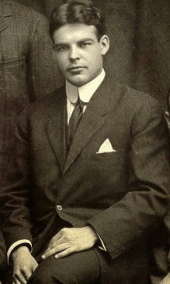
William Whiting BordenIn Cairo, Egypt, at the end of a garbage-lined alley, in a poorly kept grave yard, there is a grave stone with this inscription . . .
  Apart from faith in Christ there is no explanation for such a life.
“Go ye into all the world and preach the Gospel to every creature.”
 – St. Mark XVI 15

This is the grave of William Whiting Borden (1887-1913).

An heir to the Borden Milk Co., William was born into affluence in Chicago, Illinois on November 1, 1887. In 1894, William’s mother became a Christ follower and she began taking him to Chicago Avenue Church (now Moody Church). William soon responded to the gospel preaching of Dr. R. A. Torrey, turned to Christ and was baptized.

When William graduated from high school in 1906, his parents offered whatever he wanted as a graduation present. He chose a trip around the world. For three months, he traveled by boat, train and on foot. He came home convinced that he wanted to be a missionary. His father saw this as a youthful aspiration, and assuming he would grow out of it, sent William off to Yale to earn a business degree.

Athletic, handsome and one of the most popular students at Yale, William started a morning prayer group that soon spread across the campus. By the end of the first year, 150 freshmen were meeting weekly for Bible study and prayer. By the time William was a senior, 1,000 of Yale’s 1,300 students were meeting in such groups. Continue reading


1 Comment

What If It Doesn’t Get Easier?

Faith is a gift from God (Rom 12:3 – “… God has allotted to each a measure of faith.”).  There are times when God may give us the faith to move mountains (Matt 17:20, 20:21). But there are also times when God intends us to climb the mountain and to trust Him for the faith to do so.  Whether it’s moving mountains, or climbing them, God has a purpose for both.

What if our greatest challenge in life does not get easier? Consider these verses.

We Will Rejoice all the More at His Coming

1PE 4:12-1312  “Beloved, do not be surprised at the fiery ordeal among you, which comes upon you for your testing, as though some strange thing were happening to you; 13  but to the degree that you share the sufferings of Christ, keep on rejoicing; so that also at the revelation of His glory, you may rejoice with exultation.”

  • Question – Are you ready for His coming?

We Will Know (Have an Intimate Understanding) of His Grace & Power

2CO 12:9-109 “And He has said to me, ‘My grace is sufficient for you, for power is perfected in weakness.’ Most gladly, therefore, I will rather boast about my weaknesses, that the power of Christ may dwell in me. 10 Therefore I am well content with weaknesses, with insults, with distresses, with persecutions, with difficulties, for Christ’s sake; for when I am weak, then I am strong.

  • Thought – You won’t really know His grace & power if you don’t need His grace & power.

We Will Know Him, the Power of His Resurrection and the Fellowship of His Sufferings

PHI 3:7-117 But whatever things were gain to me, those things I have counted as loss for the sake of Christ. 8 More than that, I count all things to be loss in view of the surpassing value of knowing Christ Jesus my Lord, for whom I have suffered the loss of all things, and count them but rubbish in order that I may gain Christ, 9 and may be found in Him, not having a righteousness of my own derived from the Law, but that which is through faith in Christ, the righteousness which comes from God on the basis of faith, 10 that I may know Him, and the power of His resurrection and the fellowship of His sufferings, being conformed to His death; 11 in order that I may attain to the resurrection from the dead.

  • Question – How well do you know Him? Is that well enough?

Continue reading


1 Comment

“You follow Me.”

A devotional from Fred Carpenter, inspired by John 21…

“What is that to you? You follow Me.”

Can you imagine, walking on the beach with Jesus after His resurrection. That was the scene of an intimate encounter between Jesus and Peter (Find the full account of this story in John 21). Prior to Jesus’ crucifixion, Peter 3 times denied he even knew Jesus. Yes, Jesus already knew what was in Peter’s heart. He was giving Peter the opportunity to walk out the healing he desperately needed after his failure. Jesus then went on to explain to Peter that he would eventually die a martyr’s death. John, who would live out his natural life on the island of Patmos, was following behind. Looking at John, Peter asked, “Lord, and what about this man?” Jesus said to him, “If I want him to remain until I come, what is that to you? You follow Me!” (John 21:22).

“What is that to you? You follow Me!” For those of us who tend to compare ourselves to others, or who think we know what we need to have, to be or to do in order to be fulfilled, these words can be extremely hard . . . or incredibly comforting.

One morning, years ago, I was having a quiet time with God. Well actually, I was “belly-aching” to God. The English version of The HOPE (a dramatic video presentation of Creation to Christ) had been out for quite some time, and we had completed a handful of translations. All of our work was now related to creating and disseminating even more translations. Most of our production staff who helped create The HOPE had moved on to other things. Production people enjoy exciting new challenges, and cranking out translations of The HOPE was certainly not as creatively challenging as producing it the first time around. As I compared myself to others on my team who had moved on to new challenges, I felt like I was, in a sense, left holding the bag.

Everywhere I went, well-meaning people asked me, “So, are you working on a new project?” “No, we’re still working on The HOPE.” I would reply. Then I would feel the need to explain that each language version of The HOPE was like a new project, or that writing a 65-lesson study guide was a huge challenge in and of itself. I suppose I was trying to somehow say we were still a creative and productive ministry, even though we weren’t working on “a new project.” I understood that my significance is not in what I do, but rather in who (and Whose) I am. But still, I felt like my significance was under attack. Continue reading


5 Comments

Guiding Principles of Mars Hill

For over 35 years, Mars Hill films and videos have been used around the world to introduce thousands of people to faith in Christ. Since its inception,CMars Hill has gone through various seasons of ministry, producing different genres of media (short dramatic film, video curriculum, documentary, etc.) for diverse audiences and purposes. Each season has had, and in many cases is still having, a unique and significant impact.

The common thread that ties all of this ministry together is a set of guiding principles that influence what we do and how we do it. Perhaps you will find something of value in these principles to guide you in life and ministry.

 
The manner in which we pursue the purpose of Mars Hill
is influenced by valuing the following beliefs.

  1. The belief that at any point in time, God has a specific mission for this ministry and that He has a specific plan by which He would have us fulfill that mission
  2. The belief that through personal and corporate prayer, prayerful evaluation of relevant information and prayerful discussion, we can (as God allows) come to a conviction concerning His mission for Mars Hill and His plan to fulfill that mission
  3. The belief that this conviction, which the Bible calls faith (Heb.11:1), should be the basis of every decision and action, for “whatever is not from faith is sin ” (Rom.14:23)
  4. The belief that God will confirm the mission and plan through corporate unity as well as spiritual conviction
  5. The belief that the mission and plan will always be consistent with the Word of God, the Mars Hill Statement of Faith, the Mars Hill Mission Statement and the legal documents that govern the structure and operation of Mars Hill
  6. The belief that God will always provide what we need in order to do what He is calling us to do
  7. The belief that there are times when God calls us to do things that contradict natural wisdom. However, in such times there is still value to natural wisdom in that it gives us the ability to understand the gaps we are trusting God to fill. God makes Himself known when He does what only He can do.
  8. The belief that quality is important, because what we do makes a statement about the One we serve
  9. The belief that the ultimate measure of success is faithfulness to what God has called us to do

For more than 35 years, the stated purpose of Mars Hill has been
“To use media to draw people to Jesus Christ.”


Leave a comment

Called to Follow Jesus

God values availability over ability.
Lesson 46 from The HOPE Study Guide

INTRODUCTION

And walking by the Sea of Galilee, He saw two brothers, Simon who was called Peter, and Andrew his brother, casting a net into the sea; for they were fishermen. And He said to them, “Follow Me, and I will make you fishers of men.” And they immediately left the nets, and followed Him. And going on from there He saw two other brothers, James the son of Zebedee, and John his brother, in the boat with Zebedee their father, mending their nets; and He called them. And they immediately left the boat and their father, and followed Him.

– Matthew 4:18–22

And having summoned His twelve disciples, He gave them authority over unclean spirits, to cast them out, and to heal every kind of disease and every kind of sickness. Now the names of the twelve apostles are these: The first, Simon, who is called Peter, and Andrew his brother; and James the son of Zebedee, and John his brother; Philip and Bartholomew; Thomas and Matthew the tax–gatherer; James the son of Alphaeus, and Thaddaeus; Simon the Zealot, and Judas Iscariot, the one who betrayed Him.

– Matthew 10:1–4

After resisting Satan, Jesus came out of the wilderness in the power of the Spirit. Soon, people began to follow after Jesus. Most of these followers were common, ordinary people. But they saw something very uncommon and extraordinary in Jesus. Some left the security of their livelihoods to be with Jesus. Some of these were fishermen, to whom Jesus said, “Follow me and I will make you fishers of men.” From those who followed Him, Jesus chose an inner group of twelve. These became known as His disciples, and for nearly three years, they traveled with Him and learned from Him. They began to see the world through His eyes. As with everyone who follows Jesus, these men were being prepared for something far beyond anything they could imagine.

– The HOPE, Chapter 9

OBSERVE & CONSIDER

After resisting the temptation of Satan, Jesus came out of the wilderness in the power of the Spirit. He was ready for His earthly ministry. It wasn’t long before people started following Him. From among these followers, Jesus eventually chose a smaller group who became known as His disciples.1 Jesus lived with these men. Day after day He taught them, by word and example. He invested His life in their lives. He shaped their souls. And through this inner circle of men, God started a work and a movement (namely, the Church) that is literally unparalleled in all of history.

Now if you were going to assemble a group to start such a movement to change the world, then you might look for some extraordinarily gifted and accomplished people. But once again, we see that God often does things very differently from the way we would do them. The men that Jesus called to be among His inner circle were not the most educated or influential men that He could have found. By all appearances these were common ordinary men. Several of them were fishermen. One was a tax collector. And one was a revolutionary. But Jesus saw the potential in each of them, and ultimately God used them to give birth to something very remarkable, something that is alive today and will live for eternity. Continue reading


1 Comment

The Law – A Sacred Trust, A Holy Calling

The Law – A Reflection of God’s Holy character.
Lesson 36 from The HOPE Study Guide

INTRODUCTION

And Moses went up to God, and the Lord called to him from the mountain, saying, “Thus you shall say to the house of Jacob and tell the sons of Israel: You yourselves have seen what I did to the Egyptians, and how I bore you on eagles’ wings, and brought you to Myself. Now then, if you will indeed obey My voice and keep My covenant, then you shall be My own possession among all the peoples, for all the earth is Mine; and you shall be to Me a kingdom of priests and a holy nation. These are the words that you shall speak to the sons of Israel.”

So Moses came and called the elders of the people, and set before them all these words which the Lord had commanded him. And all the people answered together and said, “All that the Lord has spoken we will do!” And Moses brought back the words of the people to the Lord.

– Exodus 19:3-8

From Egypt, God led the Hebrew people to a mountain in a desert called Sinai. It was here God said that if the Hebrew people obeyed Him, then they would be blessed as His treasured possession, and they would represent Him to all the nations of the earth. The people said they would do whatever God asked. And so it was, with lightning and thunder, and smoke and fire, God descended upon the mountain. And Moses went up the mountain to meet with God. On tablets of stone, God wrote laws by which to live and be blessed. He gave them to Moses to give to the Hebrew people. It was a sacred trust, a holy calling. For these laws were the ways of God.

– The HOPE, Chapter 7

OBSERVE & CONSIDER

What an honor! What a responsibility! Through trials and miraculous triumphs, the Hebrew people had been set apart from all the nations of the earth to enter into a covenant with God. This covenant was centered around the Law that God gave to the Hebrew people through Moses on Mount Sinai. Known as the Ten Commandments, this Law is recorded for us in Exodus 20:1-17, Deuteronomy 5:6-21. In this covenant God promised that if the Hebrew people obeyed His Law, then they would become His people and He would bless them. If they disobeyed His Law, then He would punish them.

The blessings and curses associated with this covenant are detailed in Deuteronomy 28. While this covenant is primarily defined in terms of the Hebrew people and their relationship to God, the ultimate significance of this covenant extends to the entire world. In the Exodus 19 passage quoted above, God promises that if the Hebrew people obey Him, then they will be to Him “a kingdom of priests.” Basically, a priest is an intermediary between God and man. A priest leads people to God and is God’s representative to people. Continue reading